Sô cô la – lịch sử phát triển & văn hóa thưởng thức ở Việt Nam
- Introduction and the initial stages
The journey of chocolate in Vietnam began during the French colonial period, when cocoa varieties were introduced for experimental cultivation in the South and other suitable climates. Although not initially as popular as coffee or pepper, cocoa was cultivated early on because it was well-suited to the tropical conditions of Southern Vietnam.
Over time and after national reunification, the cocoa industry developed more slowly than other industrial crops due to its unclear value, limited processing capabilities, and restricted domestic market. However, from around the early 2000s onwards, with the support of international organizations and sustainable agricultural development projects, cocoa began to receive more attention as a crop with high economic potential.
- Development of the domestic cocoa and chocolate industry
2.1. Growing Region & Yield
Currently, regions such as the Central Highlands (Dak Lak, Gia Lai), the South (Dong Nai, Ba Ria-Vung Tau), and the Mekong Delta (Ben Tre, Tien Giang…) are important areas for cocoa cultivation in Vietnam. Dak Lak is considered the province with the largest cocoa growing area in the Central Highlands, with over 1,140 hectares of cocoa under cultivation and an annual production of approximately 1,525 tons.
In the Mekong Delta, in recent years, many cooperatives and farming households have expanded the area planted with cocoa, in some places intercropping with fruit trees or other crops to optimize land use and care. Examples include the regions of Tra Vinh, Vinh Long, and Ben Tre.
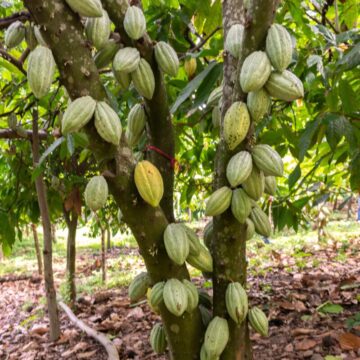
Cocoa tree
2.2. Pioneering Brands and International Impressions
Marou, Faiseurs de Chocolat: A prominent artisan chocolate brand in Vietnam, established in 2011, pioneering the production of single-origin chocolate from domestic cocoa-growing regions.
Puratos Grand-Place Vietnam: A major cocoa processing enterprise, investing in the entire value chain from farm to product. Puratos plays a crucial role in technical training and improving the quality of Vietnamese chocolate beans and products.
Alluvia Chocolate: A Vietnamese brand focusing on handcrafted chocolate, prioritizing the selection of high-quality cocoa beans, available in many specialty stores and exported to several international markets.
Belvie Chocolate: A premium chocolate brand in Vietnam, distinguished by its single-origin products and exquisitely designed packaging, focusing on the high-end segment.
TBros Chocolate : A young, handcrafted chocolate company focusing on sustainably grown cocoa beans, producing bean-to-bar chocolate in a variety of flavors.
Vietnamcacao: A domestic enterprise with many years of experience in the cocoa industry, developing cocoa powder, chocolate, and other cocoa-based products. Vietnamcacao contributes to expanding the domestic market and exporting Vietnamese cocoa raw materials https://ovo88.news/
- Chocolate-loving culture in Vietnam
3.1. Consumer habits & holidays
Chocolate treats used to be quite a luxury, usually only appearing on holidays like Valentine’s Day, Lunar New Year, as gifts, or as souvenirs when traveling abroad. Imported chocolate also once dominated the market, due to the lack of variety and quality in domestic products.
However, nowadays chocolate has become more accessible to many families, especially in large cities. Hot chocolate, cocoa powder, chocolate cakes, and other desserts are frequently found in cafes. Young people enjoy seeking out specialty (single-origin) and handcrafted chocolate bars to try new flavors and share them on social media. The habit of using chocolate as a gift or a small treat for personal enjoyment is also becoming increasingly popular.
3.2. Vietnamese people’s experiences and perceptions of quality
Vietnamese consumers are increasingly interested in the origin of cocoa: where it is grown, the cocoa variety, the fermentation and drying methods, and even the packaging – a “specialized” element in artisanal chocolate. This transparency in the value chain helps consumers trust more when buying high-quality domestic chocolate.
Cafés, chocolate experience shops, tasting workshops, and even tours of cocoa plantations are developing in cocoa-growing regions like Dak Lak and Ba Ria-Vung Tau. This not only helps consumers better understand the production process but also creates an experience that connects the flavor with the origin and the people who produce it.
- New trends in chocolate enjoyment
4.1. Flavor & Product Trends
Original chocolate (dark, single-origin), low-sugar/sugar-free chocolate, or chocolate using local ingredients such as fruit, pepper, and coffee blends are increasingly popular. In addition, organic or sustainably produced products are highly valued by consumers.
4.2. Packaging, design & distribution methods
Beautifully packaged chocolates, gift boxes, limited editions, and clear labeling indicating the origin of the cocoa – specifically the region and brand – are all receiving more attention. Additionally, online sales channels, upscale cafes, artisanal chocolate shops, and souvenir shops in tourist destinations are becoming increasingly popular distribution points.
- Economic and environmental importance
In recent years, cocoa has become a crop of focus not only for its final product value but also for its economic impact on highland farmers and the positive effects of applying sustainable methods. Technical support from the EU-funded “Circular Economy in Cacao Production” project is helping to improve productivity, income, and sustainable production practices in provinces such as Dak Lak, Dak Nong, Gia Lai, and Dong Nai.
Environmental concerns are also increasing: protecting biodiversity, reducing the use of harmful chemicals, and ensuring that soil and water are not degraded – factors that many artisan brands and organic cocoa producers are striving for.
The journey of chocolate in Vietnam, from its introduction, through its gradual production and development, to becoming a part of contemporary chocolate culture, is an inspiring story – about people, taste, and creativity.
With the ever-improving quality of cocoa, the development of domestic brands, and the growing demand for more sophisticated experiences from consumers, Vietnamese chocolate culture is entering a new phase: preserving its original essence while embracing the new – from handcrafted products with authentic, low-sugar flavors to refined tasting experiences.