
Giá ca cao giữ vững dù nhu cầu sụt giảm mạnh toàn cầu
Signs of declining demand have been confirmed: Cocoa grinding figures from Malaysia (down 35% year-on-year) and Brazil (down 17% year-on-year) show significant drops, while similarly weak data from Europe and Asia are expected to be released tomorrow
Price paradox: Despite sharply reduced demand, cocoa prices have remained stable around $5,800 per ton, thanks to continued global supply shortages, technical indicators suggesting the market is severely oversold, and the start of the main harvest season in West Africa
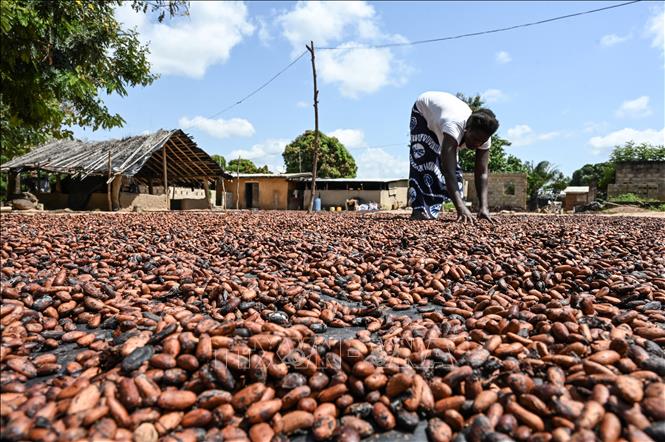
Changes in market structure: The shift from backwardation to contango https://oyo88.one/ reflects the possibility that spot prices have been oversold, or the market believes that supply for the next season will be secured, implying that prices may remain stable around the current level.
Overall, cocoa prices continued to hold steady at $5,800/tonne for the third consecutive session — a testament to the market’s remarkable resilience, especially amid extremely negative cocoa grinding data from Malaysia and Brazil, and the expectation of unfavorable https://parquedecabarceno.com/ results soon from Europe and Asia. This development raises the big question: has the market bottomed out, or is a new downturn still ahead?
Malaysia – A benchmark reflecting Asia’s struggles.
Figures released by the Malaysian Cocoa Council and the Cocoa Producers Group show a significant decline in cocoa demand across Asia:

Malaysia (Q3/2025):
Cocoa grinding volume decreased by 35% year-on-year (YoY), to only 60,780 tons.
A 13% decrease compared to the previous quarter (QoQ) compared to Q2/2025.
In the first nine months of 2025, production reached 215,169 tons, a decrease of 24% year-on-year.
This was Malaysia’s weakest third quarter in years – a country widely regarded as Asia’s leading cocoa processing hub. This decline serves as a clear warning signal for the entire region, reflecting a seriously weakening cocoa consumption situation.
The overall picture of Asia:
In Q2/2025, cocoa grinding output across the region decreased by 16.3% year-on-year to 176,644 tonnes, the lowest level for the second quarter in eight years.
The Q3/2025 data (expected to be released on October 16th) is expected to continue showing a negative trend, indicating that Asia — once the main driver of global chocolate demand — is now becoming the epicenter of the demand crisis.
Brazil (Q3/2025):
Cocoa grinding volume decreased by 17% year-on-year, to 40.1 thousand tons.
In the first nine months of 2025, total production reached 144,000 tons, a decrease of 15% year-on-year.
According to APIC, the reasons stem from excessively high cocoa bean prices, weak demand for cocoa butter, and significantly narrowing processing profit margins.
Nevertheless, third-quarter shipments were still lower than the same period last year, indicating that the situation shows no signs of improvement.
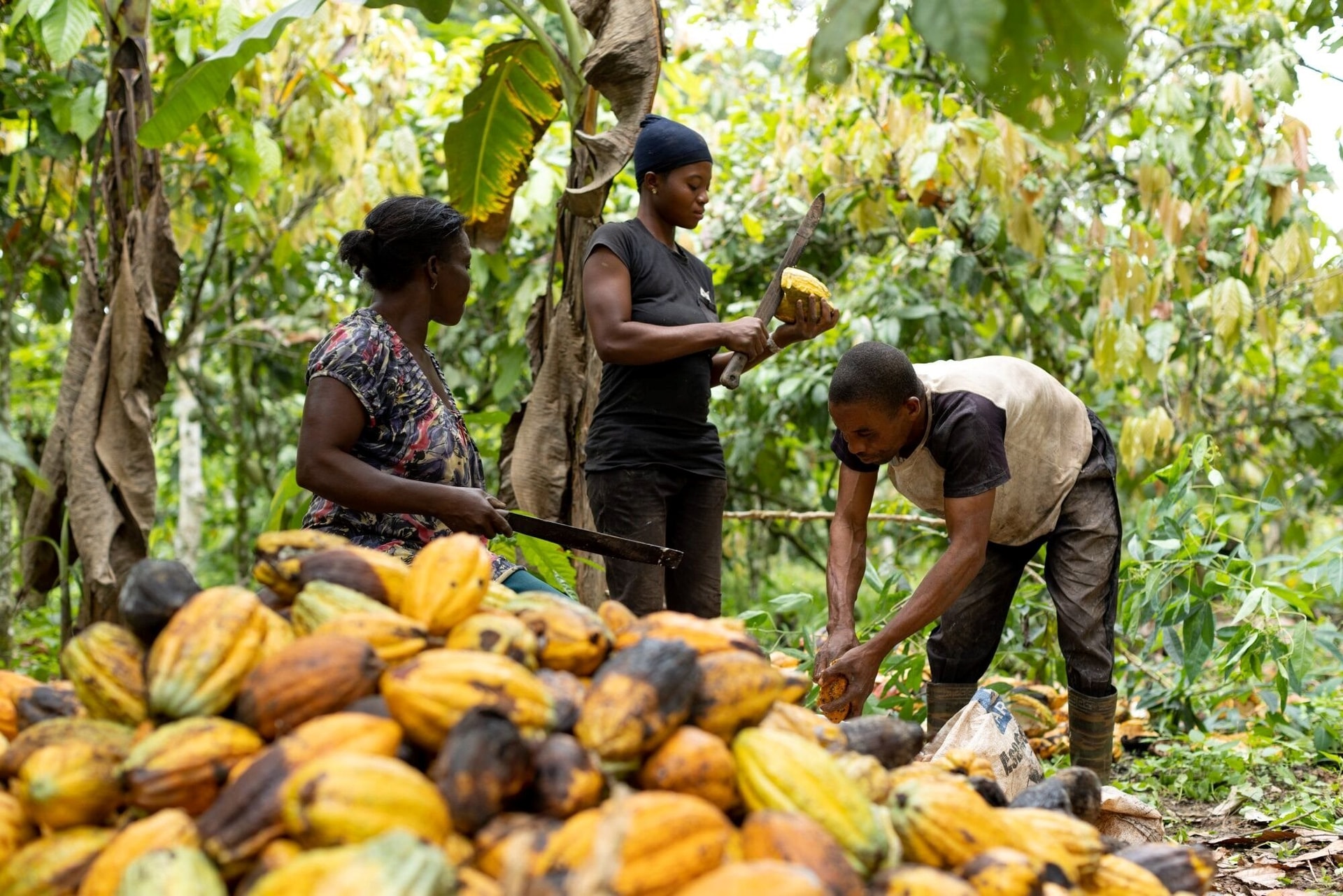
Europe – Is it experiencing a record decline?
At 8:00 AM on October 16th (CET), the European Cocoa Association (ECA) will release its Q3/2025 cocoa grinding data. Initial forecasts are very negative, raising concerns that Europe could experience its sharpest decline in demand in years.
European Q3/2025 Forecast – Sharpest Decline in a Decade
European cocoa grinding output in Q3/2025 is projected to fall to its lowest third-quarter level in at least 10 years, continuing the downward trend that began in previous quarters.
In Q2/2025, production decreased by 7.2% year-on-year (YoY), to 331,762 tons.

Germany, Europe’s largest cocoa processor, recorded a decline of up to 17% year-on-year. Some companies, such as Hanseatisches Chocoladen Kontor, have withdrawn entirely from the market, reflecting the strain on the industry.
Theo Bloomberg, các nhà máy chế biến ca cao toàn cầu đang chịu sức ép nặng nề từ sự sụt giảm nhu cầu. Dù vẫn phải xử lý lượng hạt ca cao đã mua ở mức giá cao kỷ lục, giá bơ ca cao — yếu tố quyết định biên lợi nhuận — đã giảm khoảng 75% kể từ đầu năm 2025. Từ tháng 8, biên lợi nhuận chuyển sang âm, khiến việc duy trì sản xuất ở công suất cao không còn hiệu quả về kinh tế.
Bắc Mỹ – Trụ cột thứ ba trong bức tranh suy yếu toàn cầu
Khu vực Bắc Mỹ cũng ghi nhận sự suy giảm rõ rệt trong Q2/2025:
Lượng ca cao nghiền giảm 2,8% YoY, chỉ còn 101.865 tấn, mức thấp nhất trong hai năm.
Doanh số sô-cô-la trong khu vực giảm ở mức hai con số trong vài tuần gần đây.
Tập đoàn Hershey báo cáo khối lượng bán giảm 18%, trong khi giá bán chỉ tăng 3%, cho thấy người tiêu dùng đang cắt giảm mạnh chi tiêu cho sản phẩm sô-cô-la.
Tổng thể, các dữ liệu từ châu Âu, Bắc Mỹ và châu Á cùng vẽ nên bức tranh chung: nhu cầu ca cao toàn cầu đang suy yếu nghiêm trọng, đặt ra thách thức lớn cho ngành chế biến và các nhà sản xuất sô-cô-la trong những quý tới.
Dự báo Q3/2025: Có thể là quý tệ nhất trong hai năm qua
Các dữ liệu sơ bộ cho thấy Q3/2025 nhiều khả năng sẽ trở thành quý yếu nhất trong vòng hai năm, khi nhu cầu ca cao toàn cầu tiếp tục lao dốc tại hầu hết các khu vực tiêu thụ chính. Tuy nhiên, điều gây chú ý là giá ca cao vẫn chưa giảm sâu như kỳ vọng.
Vì sao giá ca cao vẫn giữ được quanh 5.800–5.900 USD/tấn?

Dù các chỉ báo nhu cầu đều ở mức “thảm họa”, giá ca cao vẫn duy trì ổn định trong vùng 5.800–5.900 USD/tấn. Một số yếu tố nền tảng giúp lý giải cho sự kiên cường này gồm:
Nguồn cung vẫn còn hạn chế
Dù đã có sự cải thiện so với niên vụ 2023/24 đầy biến động, tình hình nguồn cung toàn cầu vẫn chưa thực sự an toàn.
Nigeria, nhà sản xuất ca cao lớn thứ 5 thế giới, dự báo sản lượng niên vụ 2025/26 sẽ giảm 11% YoY, chỉ còn 305.000 tấn.
Lượng ca cao giao về cảng Bờ Biển Ngà — quốc gia xuất khẩu lớn nhất thế giới — trong giai đoạn đầu vụ 2025/26 vẫn thấp hơn đáng kể so với cùng kỳ năm trước, cho thấy mùa thu hoạch khởi đầu yếu.
Theo các ước tính hiện tại, thặng dư toàn cầu 2025/26 chỉ đạt khoảng 186.000 tấn, một con số khiêm tốn nếu so với ba năm thâm hụt liên tiếp trước đó.
Vì sao giá ca cao vẫn chưa giảm sâu hơn?
Mặc dù dữ liệu nhu cầu toàn cầu trong Q3/2025 đang ở mức rất tiêu cực, giá ca cao vẫn duy trì tương đối ổn định quanh vùng 5.800–5.900 USD/tấn. Diễn biến này được lý giải bởi nhiều yếu tố cơ bản và kỹ thuật hỗ trợ thị trường trong ngắn hạn.
- Nguồn cung vẫn còn hạn chế
Dù đã thoát khỏi khủng hoảng nghiêm trọng của niên vụ 2023/24, cán cân cung cầu toàn cầu vẫn ở mức mong manh:
Nigeria, nhà sản xuất lớn thứ 5 thế giới, dự báo sản lượng 2025/26 giảm 11% YoY, còn 305.000 tấn.
Lượng giao hàng ban đầu về cảng tại Bờ Biển Ngà – quốc gia xuất khẩu ca cao lớn nhất – vẫn thấp hơn đáng kể so với cùng kỳ năm ngoái, cho thấy vụ thu hoạch khởi đầu yếu.
Thặng dư toàn cầu 2025/26 ước tính chỉ khoảng 186.000 tấn, con số nhỏ sau ba năm thâm hụt liên tiếp, cho thấy rủi ro cung ứng vẫn hiện hữu.
- The futures market is oversold.
Major organizations such as Citi and Société Générale warn that the cocoa market is in a state of “extreme oversold,” with selling pressure having reached its limit.
On the London Stock Exchange, speculators have shifted to net short positions – for the first time since August 2022.
This is often seen as a potential signal for a short-term upward correction, as many investors may soon take profits or reverse their positions.
- The psychological threshold is $6,000 per ton.
The $6,000 level previously acted as strong technical support, and the current price around $5,800 is only slightly lower.
Since its peak in December 2024 ($12,906), the price has fallen by approximately 54%, reflecting a significant correction.
According to Trading Economics, cocoa prices are projected to stabilize around $5,604 per ton by the end of the quarter, with the worst-case scenario being a drop to $3,000 per ton — this would only occur if supply continues to improve significantly and demand continues to weaken further.
Furthermore, current farmer prices in Ivory Coast at $4,000–$5,000 per ton may limit the extent of the prolonged decline, as lower prices would discourage farmers from selling.
- Seasonal factors – the start of the main harvest season in West Africa.
The main harvest season in West Africa is entering its peak.
Ghana has just increased its farmgate price by 12%, to 58,000 cedi (equivalent to $4,640 per ton), following a similar move by Ivory Coast.
Higher purchase prices can encourage farmers to sell faster, but also help support the overall market price level.
History shows that early October is often a time when prices recover, as the market reassesses the actual yield of the harvest. If the yield is lower than expected, prices can jump 10–20% in the short term.
- The price structure and market situation have returned to a “normal” state.
According to Bloomberg Finance LP, the price spread between spot and one-year forward contracts has now shifted from backwardation to slight contango.
This difference remains small compared to historical standards, suggesting the market is finding its way back to equilibrium.
The normalization of the futures curve suggests that prices tend to stabilize around the current range ($5,800–$6,000/ton).
Short-term outlook
Cocoa prices have stopped falling for three consecutive sessions, and tomorrow’s trading session is seen as a decisive moment in determining the next direction.
A drop to $4,000–$5,000 per ton could be a positive sign for the processing industry (thanks to lower raw material costs).
However, a lack of liquidity in the futures market can lead to large price fluctuations in the short term.
Meanwhile, a 10–20% recovery scenario remains possible if delivery data is weak and actual supply is lower than expected.